Showing posts with label Development. Show all posts

SØLUND PROJECT

As mentioned in my previous post, about our model workshop, I promised to do a post on the actual winning proposal on the real site as soon as it was published. I expected it to appear a few weeks after my previous post, but to my surprise, it came only a few days after.


The winning project is designed by Copenhagen-based Entasis architects, who have designed the projected in collaboration with WITRAZ architects, who have especially been involved in the design of the landscape(s) created on the site. The buildings and landscape on the site are expected to stand complete by the year 2018.
Just by looking at the bird's eye picture above, the approach to the site is quite clear. The architects have followed the block structure of the neighbouring buildings and continued it onwards. At the the last plot of the site, the architects have chosen to leave the area empty for a public park instead of completely filling the site with the institutional buildings. The kindergarden is the white building placed closest to the lake at the bottom of the site.


As for the architectural language of the project, the new buildings have almost strict, contextual facades that strongly relate to their surroundings. As a whole, the architects themselves describe their project as a direct continuation of the local urban-structure (also architecturally), rather than being a more radical or different architectural site in relation to the surroundings. The picture above shows how the new buildings follow the structures surrounding it, acting as a natural continuation of the street scene.


There are many elements of this winning proposal that can be discussed. First of all, the direct continuation of the block structure is very questionable. Guru and I (our group from the Model Workshop) had a similar approach as a part of our concept process. It seemed natural to continue working on the site in a contextual sense, but we rather quickly learned that the scale would be to large and this development would seriously limit the possibilities for views from the different rooms. As a matter of fact, Entasis' and WITRAZ's approach has created such a density on the site, that it not only leaves the vast majority of rooms without views towards the lakes, but also introduces a height that would allow very, very limited sunlight in the courtyards created, thus making them uncomfortable, perhaps even claustrophobic. It is like all the buildings are squeazed into one part of the site, in order to open up for a park. In our group, we believed that it seems more harmonious to evenly spread out the buildings, in order to create varying outdoor spaces from private to semi-private and public. 


Also, the location of the kindergarden is questionable, since I believe it would be more suitable for it to be located facing the newly created park, rather than steal the view of the lakes from the elderlys lving there. As for the facades, I believe that the archtitects have made a right choice here. They relate contextually to the surrounding buildings in a positive way, as well as adding some more modern details, such as the roof areas and also at buildings such as the kindergarden's facade. Furthermore, I am curious to see whether or not the newly defined park area will actually function as an active recreational area. It is well defined as a space in my oppinion, but I can't see how well defined the expected activities of the park are. It seems to be a bunch of trees with some paving around them and a few benches - you would expect more from such a vital location in my oppinion.


To sum things up, I generally believe that the architects could have had a greater focus on integrating the site actively with the green pathways around the lake, rather than closing the institutional buildings up even more, in order to strictly stick to the context of the area. This is perhaps an example of the result of too strict contextual design. As always, the visualizations of the project are optimistic and light, but I am very sceptic as to the actual outcome due to the highly concentrated density, lack of a variation in public, private and semi-private exterior spaces as well as the lack of views from the rooms. It is naturally hard for me to not be critical towards this project, due to my personal relations and readings of the site as a result of our model workshop, so I am also looking forward to see how the final result works out (but there is a long time till 2018!).

Further reading:
- Entasis Architects
- WITRAZ Architects

- Andy Minchev

SCALA SKYSCRAPER

About three months ago, I wrote a post about the new development on Krøyers Plads - A building site, which has remained empty for many years, due to a lack of a suiting project. Having mentioned this, there is yet another site in Copenhagen which has so far face a similiar destiny - Axeltorv. Situated on Axeltorv, is Scala, a building once built as an entertainment center in the very heart of Copenhagen, filled with bars, restaurants, an arcade and even a cinema. Unfortunately, this building never recieved much attention despite its spectacular location (it lies between the main entrance of Tivoli, and the circus building in Copenhagen). The lack of visitors resulted in practically the entire building closing down. The building's unfortunate faith continued over the years, as each new owner entered bankruptcy, one after the other, due to the financial crisis. As the building kept changing owners at the rate of the change of seasons, eventually it would find an owner that was serious about tearing the building down, and projecting a skyscraper on the site, to revitalize the urban image of the site. The competition was won by the now infamous BIG architects with the following proposal:


As it has become a bit of a tradition in Copenhagen, this high-rise project provoked great debate amongst Copenhageners - some argued for the need to develope more high-rise projects in the capital, while others argued that this would ruin the charming historical feel of the inner-city area. Little did they know, that the owners of the site would follow the faith of their preceders, and yet again fall into the hands of bankruptcy and once again fail to make a change on the troublesome site.


About a year ago, a Copenhagen-based lawyer firm finally proved to be the stable owner of the site, and today, the building is in the process of being torn down, to make way for the new creation on the site. This new creation has been designed by Danish Lundgaard & Tranberg architects - a rather succesful architectural studio, which have designed buildings such as the SEB headquarters building by the waterfront, the Tietgien Dorm, Skuespilshuset (The Actors' House by the waterfront) and other works of a mostly noticeable scale. The first concept model of the project is seen above.

The project is still in a concept stage, and the models and illustrations provided by the architects aren't sure to show the final result. The shape of the project relates to its surroundings - The circular shape mimics the circus building behind it and a little water pool on its western side. The heights are carefully chosen in order to integrate the building with its surroundings, despite its somewhat dominant scale. As illustrated above, the highest of the five towers relates to the Golden Tower in Tivoli, while maintaining a height that respects Arne Jacobsen's SAS Hotel building. Each of the five towers relates to it's surroundings in height, i.e. the one facing the circus building being lower to reach down to it. The idea of having five towers, is to easen the dominance of the skyscraper scale, and create spaces for shops and cafés in between the gaps, thus minding the human scale, and creating a skyscraper that actually contributes to the city life in the area.


Above is a very early and mostly conceptual rendering of what the towers might look like, as seen from the City Hall Square (notice that the view to the SAS hotel is respected). In my opinion, I was at first a bit afraid that the five towers are perhaps a bit too much for the site, since they might steal too much of the attention from the neighbouring Tivoli entrance and the circus building, which I believe to be two very fine buildings. Building on such a central site is always tricky, due to the great impact on the surroundings, but with the architects having minded the human scale of the site, I believe this project will work out. It is of course hard to tell for now, due to the conceptual level at which the project is, at the time being, but I'm following on the development with great interest, and I trust that Lundgaard & Tranberg will bring us a promising project at the end of the day.

Further reading:
- Lundgaard & Tranberg Architects

- Andy Minchev

KRØYERS PLADS - COPENHAGEN, DENMARK

Krøyers plads is a plot of land located in an extremely attractive area, right out to the Copenhagen waterfront, on the opposite side of the charming restaurant and bar area of Nyhavn. This plot of land has stood empty for over a decade, due to issues with finding an architectural project that suits the desires and needs of the local population in the Christianshavn area (a bunch that are always rather capricious and critical towards any new developement in the area). But after all this time, the local population, the municipality and the architects of this new project have finally come to an idea, which they all believe suits the needs and wants of all the parties involved. The result is a project that follows the historical structuring of the historical warehouse buildings along the waterfront, while giving the area a fresh new twist as well. With a new cyclist and pedestrian bridge being built across the channel in the same area, it is expected that life and social activity in this otherwise quiet area will grow at the completion of the projects. Do mind, that the pictures of the new project, are the ones right after the one underneath, which is the first submitted project, that was canceled, due to complains about its dominant height.


Above: The first proposal for the square, by the Dutch architect Eric van Egeraat.
Below: The current proposal, by Vilhelm Lauritzen Architects and COBE Architects. 


Further reading:
- http://goo.gl/mf8bn

- Andy Minchev 

ARTIFICIAL TREES

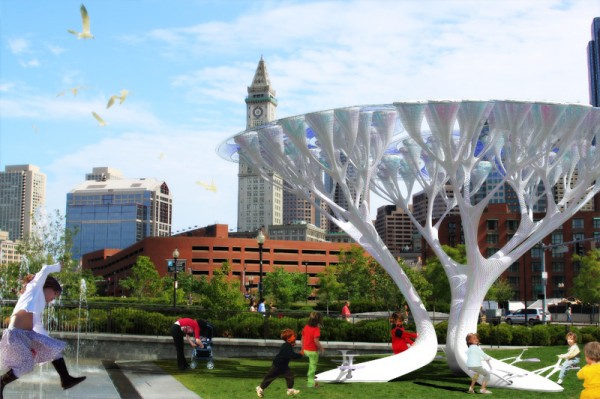
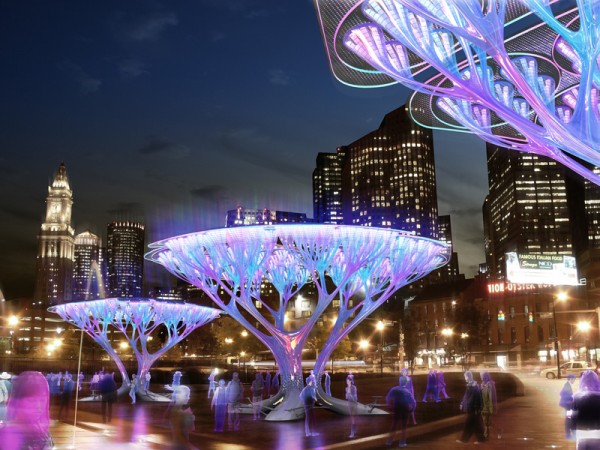
Lately I'm busy with yet another workshop at the architectural school, so lots of material is to be expected by next week. In the meanwhile, here's a thought-provoking project that I found on eVolo's website - a website that focuses on innovative architecture. The project is, as the title of this post implies, about an artificial tree.


The interesting thing about this tree, besides it being a pretty litteral example of biomimicry, is that it has vastly superior environmental impacts than that of a normal tree. This artificial creation has the carbon neutralizing effect equivalent to over 100 natural trees! This incredible feat is achieved by various technological elements that are implanted and integrated into the tree structure. Furthermore, the artificial tree is made to fit in the urban landscape, with features such as benches by the roots and a marvelous lighting system during nighttime. The entire system of the tree runs on sustainable off-grid power systems that harvest the wind and the sun. The structure is designed for the city of Boston, and is thought to be built in plenty of numbers, so that the city's polution is minimized, and so the negative impacts of industrial developement can be minimized.


Personally, I think the most interesting topic about these artificial trees, is centered around their possible impact. Let's say that the Boston city council approve construction of these structures, and they turn out as effective as they are assumed to be on paper and drawing. What if this concept spreads around the world. Sure it will be a postive thing, being able to neutralize carbon so easily, while also adding beautifaction to global metropolises, but is it ethically right? I'm a very open-minded person regarding many contemporary subjects and as in this example, also technology. But the ability of being able to create trees, that are more effective than real-life trees, won't that be a bit of a problem? I imagine cities cutting down "the old trees" to build such ones. Imagine the urban landscape without any actual vegetation, but rather boulevards of artificial robo-trees. Such a development could lead to extinction of wildlife in urban areas, and with time, even justify massive woodcutting in the developed world, as well as the more fragile parts, such as the rainforests. My vision may be pretty exagerated, but then again, the world developes quickly, and you never know what might happen.

Further reading:

- Andy Minchev 

WASTE PLANTS AND AMUSEMENT PARKS

Most modern cities are still plagued by huge dull and gray industrial buildings. Buildings such as factories and powerplants. What do these have and common and why are they so ugly? Well basically, they are completely functional structures - They are designed in a way that only serves their function, and in a way that is as economically cheap as possible. The result of designing in such a manner has resulted in massive unwelcoming structures, that are intended solely for the use of workers and for production. To be fair, there are people who actually like such buildings and rural industrial areas, due to the murky and somewhat mysterious dystopian spaces that they create, but let's face the facts, I can surely say that the majority of the public dislikes such buildings and areas. But what if such buildings were to be made more welcoming to the general public? What if industrial buildings and their surroundings became areas of great entertainment and pleasant places, which one would joyfully want to visit?


The picture above is a rendering of the infamous Danish architect, Bjarke Ingels' (BIG) newest project. The project is a design for a waste-to-energy plant just four kilometers from downtown Copenhagen. As you may have noticed, the building may not look much look as a traditional industrial plant, and guess what, it really isn't. As a matter of fact it as a building that flirts with architectural styles of the likes of Las Vegas. The thing about this structure is, that besides being a waste-to-energy plant... It also functions as an all-year ski slope!


Now having mentioned the possibilites of making industrial areas more appealing to the general public, this is a perfect example of what I'm talking about. Making a building that normally would repeal people into a tourist magnet and a popular activity area (and yes, I'm quite sure that this building will become extremely popular, due to the fact that Denmark has just about no mountains, and quite the few skiing and snowboarding enthusiasts). There is no doubt that this sort of industrial architecture can render empty industrial areas into the likes of amusement parks! By going for a Las Vegas Effect in a desert of industry, this building may just prove that rethinking such structures can perhaps change the ways people interact with entire neighbourhoods. 


It is of course too early to judge the success of this building. The concept seems ideal, but even so, time has proven that anything can happen in the world of architecture. This new waste-to-energy plant has furthermore some (discussible) flaws and issues, such as aesthetic problematics. The thing on that point, is that I believe that the structure is just a bit too massive. It is clear that it is supposed to symbolize a mountain with the ski slopes and everything, but I have to tell you that the area around it is rather flat, so the structure might become far too dominant. Furthermore, some details about the concept seem a bit kitschy, such as the pine trees on some of the levels of the structure - This, I believe, crosses the border between a symbolic mountain design, and one that almost directly resembles a mountain, thus once again creating a bit of a cheesy structure. But that of course is a thing of aesthetical opinion. Besides such details, I believe this structure will dramatically change the attractiveness of the industrial area, and might as a matter of fact begin a new architectural trend in industrial design. Who knows, we might just end up having rollercoasters on factories and waterparks in warehouses some day!

Further reading: http://www.big.dk/

- Andy Minchev